Michael Bennett I Didnt Know Whether Id Ever Be Able to Hold My Girls Again
The Cheers Conspiracy
Before in that location was the place where everybody knows your name, there was Park St. Under, an eerily similar local sitcom. Did it quietly serve as the basis for the most famous TV bear witness about Boston e'er made?
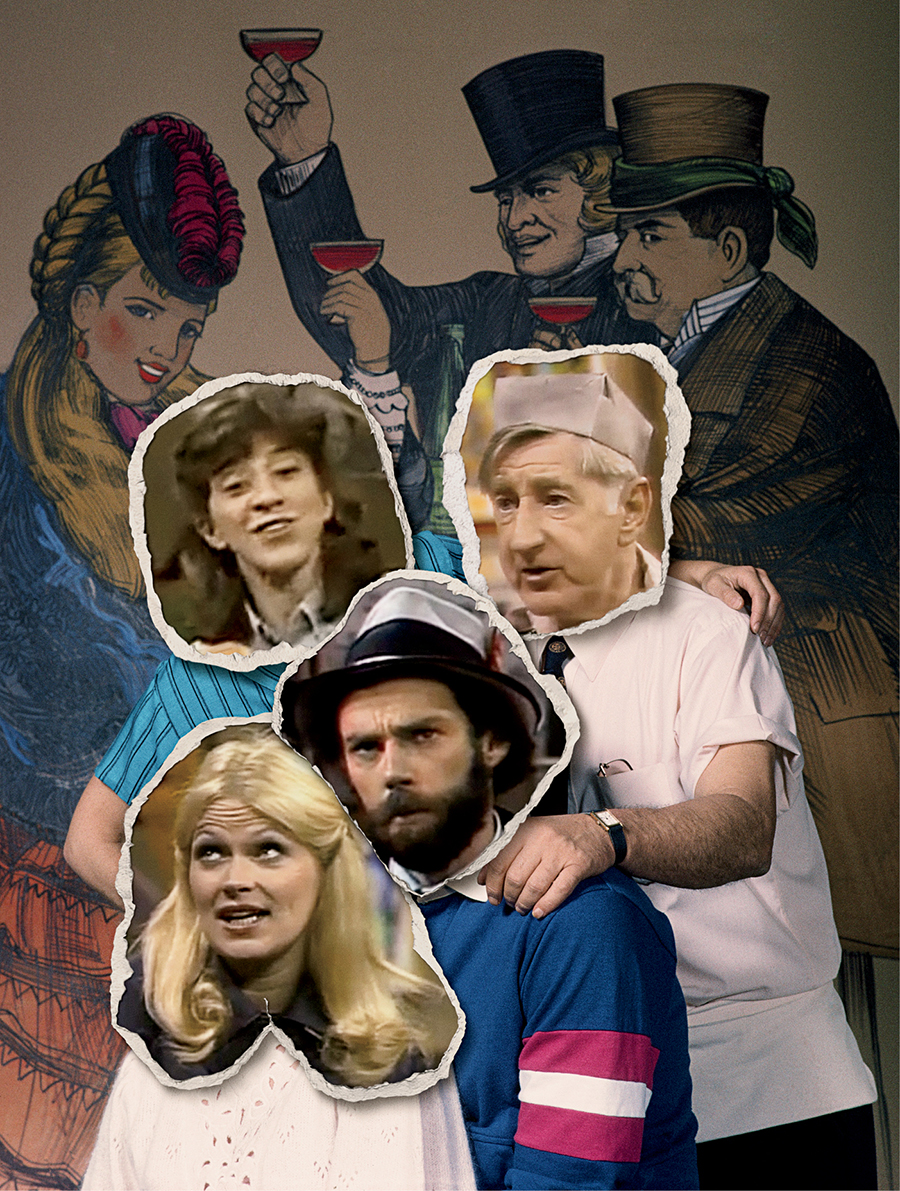
Photo illustration by Andrew Davis
A few days after the official start of fall in 1982, the headlines were a bleak reflection of life in Ronald Reagan's America. Tensions between the United States and the Soviet Union were on the rise again, the nation's economy was still dragging itself out of a recession, the Steve Miller Ring's "Abracadabra" topped the Billboard Hot 100, and the top-rated Goggle box programs included The A-Team and Falcon Crest. Few knew it yet, but a new show was about to debut at the end of September on NBC. In time, an doting fan base (especially in Boston) would lionize it as a new classic—a hallowed place on Th nights where everyone knows your name.
Thanks would go on to earn a special spot in the collective pop-culture consciousness, winning 28 Emmy Awards, lasting for 275 episodes spanning three presidential administrations, and seriously pissing off at to the lowest degree 1 late-dark talk-show host when the cast showed up drunk for a alive taping of The Tonight Show after the serial finale (25 years ago this spring). It's hard to think about a world where Thank you didn't exist, and most people with whatever kind of connectedness to the show'southward legacy, or to Boston, for that thing, wouldn't desire to try.
Simply three years before Sam, Diane, Frasier, Carla, and Norm, there was another grouping of quirky barflies on the airwaves effectually Boston. September 1979 marked the debut of Park St. Under, a show (finish me if y'all've heard this 1) about a Boston neighborhood bar, led past a Red Sox player turned bartender; a curt, dark-haired employee with attitude; a earth-weary civil servant working for the local government; an absent one-time-timer offer comic relief; and aye, even a local psychiatrist turning the show's barroom into a regular place of both business and play. Produced in Needham on a modest budget, it has been touted equally the first local, independent weekly sitcom e'er fabricated, and during its curt run it revolutionized ideas of what an independent broadcast Television station could do. Maybe most important, it was a hit with Boston audiences before it faded into the popular-culture ether.
While the world has all but forgotten Park St. Nether, a few true believers remember it as a novel, hyper-local show—and insist that its legacy, to the extent that it has 1, is as the sitcom that inspired (or was possibly ripped off past) a agglomeration of out-of-towners who made Thank you, the most famous show e'er nigh Boston. The tale has persisted as a nugget of local trivia, an urban legend stoked by hometown pride that gets dredged up every then oft, or gets posted on Reddit. It'south the "story that will not die," sighed the Globe in 2001. Fifty-fifty the official history of Channel 5, which produced and aired all 36 episodes of Park St. Under between 1979 and 1980, reads: "WCVB is the offset station in the country to produce a weekly one-half-hour sitcom. The plan is said to exist a precursor of Thanks."
But was it? I decided to find out.
In many ways, Park St. Under's fleeting success was a production of the times. In the tardily 1970s, local airwaves were filled with cheap, low-ambition, cookie-cutter schlock. While network TV was headed into an exciting new age, local stations mostly served equally manual points for big-budget shows in syndication. If profit was your motive, there was little incentive to dip a toe in the product game. In this wasteland, though, Boston's ABC affiliate, Aqueduct 5, stood out as a renegade.
Starting in 1972, when a progressive-minded brain trust of academics, industry professionals, and media idealists called Boston Broadcasters Incorporated (BBI) took over the station, WCVB had pursued the civic-minded mission of producing skilful, original TV that spoke to the needs and interests of the people and communities it served. And it was good TV. Under the guiding manus of founding full general manager Bob Bennett, the station became a place of experimentation and innovation that pushed the premises of what a local outfit was thought capable of. Enough of it worked that Television set fable Norman Lear (of All in the Family fame) after told the New York Times that Bennett was "the best local broadcaster in the nation."
It didn't take long for WCVB to attract serious national attention from the networks. Its morning news bear witness, Good Day!, which get-go aired in 1973, was such a hit that ABC used it as the model for Practiced Morning America, which premiered two years later. The Baxters, an "interactive" sitcom that dissever its fourth dimension between the moral quandaries of a suburban family unit and an audience discussion, was picked upward for national syndication by Lear in 1979. "It was a new venture, in some ways, for a local TV station to do that kind of prime-access show," says Ted Reinstein, a reporter for Chronicle (some other WCVB creation) who briefly had a role on Park St. Under. "They did outside the box."
So why not endeavour a comedy?
When Park St. Under premiered in September 1979, its appeal was steeped in the WCVB ethos: It would offer, in granular particular, a reflection of life in and around Boston, addressing neighborhood-level gripes and woes with people who looked and sounded like the same folks yous'd find sitting side by side to you at any local bar. With plot points taken direct from the pages of the Globe and the Herald and a subversively advised sense of humor-as-grade-warfare swagger, information technology was similar a large within joke. And it was a revelation.
Viewers would become a whiff of this townie vibe right from the show's opening theme—a bluesy shuffle absolute by era-correct saxophone riffs and hometown-crowd-pleasing shoutouts, originally recorded on a 4-track. And it's damn catchy.
Bos-ton! Bos-ton!
The T's running late/Heating on short
The taxes keep climbing/Male monarch'south holding courtroom
Tuition increases/Students don't cheer
Sports fans always cryin'/Await till next yr!
It's truthful that living costs a lot/But no city'south got what Boston's got
Large-city life gets too confusing/Find a place that's amusing
Where'due south that, you lot wonder?/Park St. Nether
Equally the theme rolls, so do scenes of iconic Bostonia that changed regularly, such as the T slithering across the Longfellow Bridge, Haymarket merchants, a rookie Larry Bird driving in for a lay-up, traffic downtown equally an MBTA bus rides the tail of a motorcar. And naturally, the characters got their due during the freeze-frame actor introductions.
In the original bandage, there'south Reddish Sox star turned Park St. Under bar owner Augie, played by local comic-on-the-rise Steve Sweeney, blasphemous at the sky over a parking ticket. And so, smiling over the pinnacle of a newspaper, is the flighty waitress Bonnie, played by Karen MacDonald, one of the founding members of the American Repertory Theater at Harvard. MacDonald also sang the theme, tweaking the lyrics each week to include some tidbit from the headlines, be it cutbacks in MBTA funding or the latest Red Sox implosion. "All stuff to brand it topical," she told me. Marvin, the droll MBTA driver, waves as he emerges from the actual Park Street T finish in full uniform. He was played by Jim Spruill, a local thespian and beloved BU professor. Brad Jones every bit Harvey, the resident balding shrink who doles out expertise or gibberish to whoever'southward bellied up to the bar, rounds out the original cast. Over time, characters such equally Fitzy, a dimwitted elderly bartender played by Charles Welch (better known, possibly, every bit the Pepperidge Farm guy), and the venom-tongued, dark-haired cook Maxine, played past Lanie Zera, joined the testify. As the opening song fades, the camera takes us downwards the concrete stairs and into the eponymous bar.
Sure, it looked a fiddling hokey and fly-past-dark, but that'south merely considering it was, shot on a shoestring budget and tight deadlines. WCVB producers made each episode for $ten,000 at a fourth dimension when the cost of network sitcom installments was rising to $i million apiece. Local and New York–based talent would arrive in Needham on Fri night and run through the script before shooting in front end of a live audience on Sabbatum. Lord's day was for editing, and every Monday night for the class of its life the prove would air at seven:xxx p.m.—a two-day turnaround. It was a manic, wild passion project.
The prove was an almost instant hit. For the commencement time, Bostonian identity, ethos, and pathos had its own Telly sitcom, and people loved information technology. Despite the rough edges, it spoke to people in the urban center. But the magic couldn't last, and the program experienced one shakeup subsequently another. Between late 1979 and March 1980, casting changes sent MacDonald, Jones, and Zera back to the stage, and Spruill returned to BU. Eventually Sweeney was replaced by Lou Criscuolo, who played bar-purchasing businessman Nick DeMarco, when the producers wanted a more than professional actor. Scripts began targeting a national audience and soon the Boston feel disappeared, as did the local eyeballs. Past June 1980, the show was killed for skillful. And that seemed to exist that.
Just it wasn't. In 1982, a friend of head author Arnie Reisman who was working at an NBC affiliate in Washington, DC, told him well-nigh a new show planned for national debut in the fall and mentioned that he might desire to have a look. He taped a re-create and secretly slipped it in the mail to Reisman. It was the Cheers airplane pilot. "Information technology was pretty much a re-create," Reisman says. "We called over Bob Bennett and showed him the record. You watched all the crimson go to his confront. Nosotros thought he was going to burst a blood vessel."
In an historic period when the whole history of popular culture seems to exist merely a Google search away, it's piece of cake to forget the things that are existence lost to time—the bits of cultural ephemera that don't quite make the cut for athenaeum and digitization projects. In Television receiver, for every defining show that'southward carefully saved for futurity generations, untold others rot away or get tossed when storage is tight. When I first heard the theory that there was a Boston testify that had been Cheers earlier Cheers, I fully expected to observe that I'd simply missed out on a well-known hole-and-corner. Except I couldn't notice much information about it: just a dodgy Wikipedia page sourced to a expressionless link, a clip of the opening credits, and a grad educatee's web log post that pulled all the rumors together. WCVB, I'd heard, had dumped its archives of the show. At that place was nearly naught to advise that the sitcom had survived—outside of a dwindling collection of crumbling memories.
As my research led down one dark aisle after another, I started to wonder if the legend of Park St. Under and Cheers was more like a game of telephone in which someone had overstated the similarities of the two programs and the story had gotten twisted over time. Afterwards all, in that location are only so many ideas nether the sunday, and setting a prove in a bar—the kind of place where creative types spend a lot of time—and setting that bar in Boston, a town that'south no stranger to drinking, is not exactly revelatory.
Without an annal to go to for answers, I went to the next-best thing: the people who made Park St. Under. And they're certain the creators of Cheers shoplifted their show.
"I was like, Are you fucking kidding me? " Zera recalls thinking afterwards watching Cheers debut. "Are they immune to do that?"
"Nosotros didn't know all the details, simply we heard from the people at WCVB near this new testify that was a rip-off of Park St. Under," MacDonald says. "We saw information technology and were similar, Wow."
"In that location was no question. It was a direct rip-off," Sweeney says without hesitation. "It felt similar a personal rip-off for me."
Bob Bennett, who died in 2016, told the Earth: "It was heartbreaking to have it stolen."
While there's no shortage of accusations, there seems to be a dearth of definitive proof. Thanks director James Burrows has long denied his show was lifted from Park St. Under, maintaining that it was inspired by Duffy's Tavern, a radio programme created in the 1940s by his begetter, Abe, a Tony Laurels–winning humorist and writer. The troika of Cheers creators—Burrows declined to annotate, and Les and Glen Charles did non respond to attempts to accomplish them—claimed to have modeled the Cheers bar on Boston'southward Bull & Finch, which they visited while developing the sitcom.
After Cheers beginning aired, quondam Park St. Under bandage members say, at that place were rumblings of lawsuits and other attempts to fight back. Bennett had been aiming for a task with ABC and had made a reel of WCVB programming that was circulated to network evolution offices, fueling theories that someone had seen information technology and lifted the thought for Cheers. In the end, though, no ane idea they could win. And fifty-fifty if they somehow did, television is a tight business, and no one likes a troublemaker. "It's a David-confronting-Goliath situation," Reisman says. "Merely David doesn't even take a slingshot."
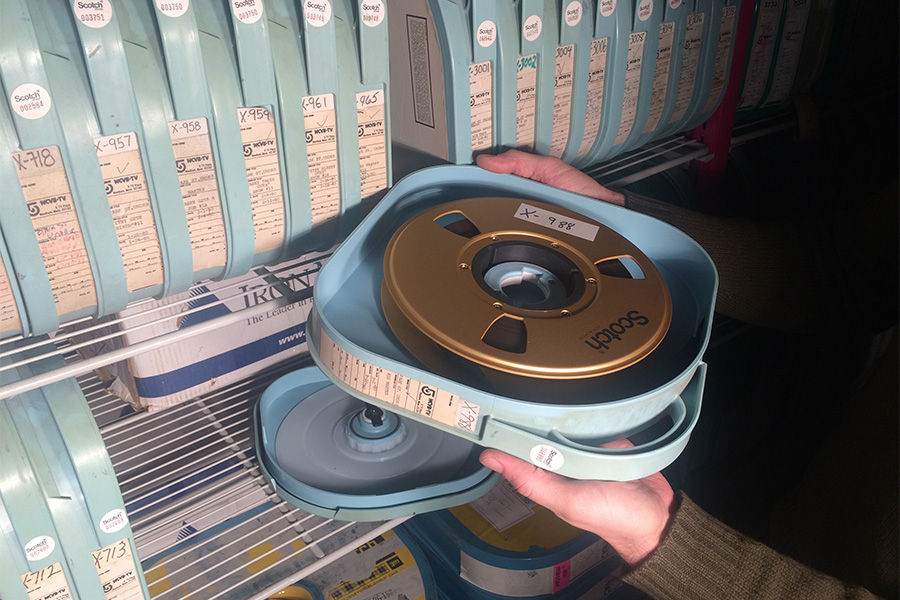
Photo by Michael Hutcherson at Northeast Celebrated Moving-picture show
Since the Cheers controversy never fabricated it to a courtroom, I figured the but mode to discover out if it was a rip-off was to rail down the original Park St. Under footage, if it still existed, and judge for myself. Turns out, it's in storage in Maine.
In 2014, heaps of quondam WCVB tapes were slated to be hauled off to the dump. It was then that David Weiss, the managing director of Northeast Historic Film, a nonprofit archive in Bucksport, Maine, got a telephone call from a friend and sometime Chronicle producer. A few years before, two artists named Michael Hutcherson and Gary Fogelson had created a retrospective evidence that highlighted WCVB's heyday. The producer asked Weiss if the annal wanted the stuff bound for the trash heap. Weiss said yes, and the collection was plastic-wrapped, put on pallets, and shipped upwardly to Maine in bulk. A room total of original masters of all sorts of WCVB programming was listed on the inventory of items, and Park St. Under was amidst the booty. Merely while the tapes are safe, no one has watched, let alone digitized, the entire collection.
Even though I couldn't view the whole series, I was able to sentry enough episodes—from both early on and late in the run—to get a gustatory modality of what everyone was talking about. Take, for instance, the Halloween episode from the get-go season. The subterranean pub has a dark-forest bar with brass trim, and the exposed-brick walls are chaotic with typical Boston tavern junk. To prepare for the bar'due south party, the place has been decorated with pumpkins, and Maxine, doing her gaudiest Julia Kid, is conjuring "Quincy Market–Style Halloween Brew" (Kraft singles, the face oil of "out-of-towners," some pot, a "splash, nearly two gallons or and so, to gustation" of Wild Turkey) when a despondent old woman schleps into the bar. She's being forced out of her apartment in the South Finish, she complains, because information technology's being turned into condos. Augie rolls his eyes and groans, "How'yard I gonna get Quinzy Mah-ket types in heah with her type in heah?"
The resident bar shrink, Harvey, sidles up to her like Frasier Crane hearing the cries of a soul needing psychiatric expertise across the airwaves of Seattle.
Harvey: "Look, I'm Dr. Harvey Dorfman. I wrote the volume Success Through Fright. [Audience laughs.]…I live in the S End, then perhaps I tin can assist you. And I'm a psychologist, so I'm qualified to assistance you. And I'k sympathetic, so I'd like to aid you. Can I help you?"
Woman: "Become lost. [Audition laughs.] I'k a victim of condo perversion."
Harvey: "You lot mean condo con-version."
Woman: "That, too." [Audience laughs.]
Information technology's pretty standard sitcom stuff, if non the most polished, simply then the episode takes a civics-lesson detour that never would have made it onto a network show. Bonnie remembers a new facet of the city's rent-control laws that might aid the quondam lady out. "Hey, White stole that idea from Timilty!" Harvey snorts, dragging in a wonky quibble from the mayor's race between Kevin White and Joseph F. Timilty. They both call folks they know in White's office on the bar phone, but the arc is never completely resolved.
Finally, the episode ends with Bonnie ("Dorchester'southward ain!") delivering a peacocking operation of the Gershwins' "I've Got a Shell on Y'all" to Augie with a dash of early Sam-and-Diane-esque, will-they-or-won't-they tension. Ringlet credits.
So, is information technology Cheers?
The similarities between the two make an statement for some kind of influence. The question of whether Cheers took something from Park St. Under, however, obscures something vital: Equally special as the little Boston sitcom was, and in that location'southward reason to think it was truly loved, it was never going to be Cheers. It had its shot. ABC Entertainment president Tony Thomopoulos had met with Bennett and seen the show after hearing how cheaply the episodes were being fabricated. He told Bennett, "I like them, but I simply desire to tell y'all they're really not deserving of beingness on the ABC network level. Just how are you doing them at that price?"
1 reason, peradventure, why the fable lived on so long is that Cheers affirmed that there actually was something corking about Park St. Under. "I was possessed the moment I first saw Cheers," says Robert Patton-Spruill, son of Jim Spruill, who was unflinching in his position that the show in one mode or some other was robbed by Cheers. Every bit a kid, he relished knowing what he calls the "real story," and takes pride in his begetter'due south Park St. Under legacy. Had the series caught on nationally, he says the elder Spruill—the only African-American member of the cast—wanted to use information technology as a platform to talk about issues facing black and inner-metropolis communities. "I mean, he represented 'the diversity guy' on the show," Patton-Spruill says. Patton-Spruill proudly carries the conspiratorial torch for the show on behalf of his father, however accepts it's but i of those things. "The show has been off the air for twenty years," he says. "At that place'southward nothing for them to gain by saying on their deathbed: 'Yes, by the way, I stole Cheers from Park St. Under.' That'south never going to happen."
To me, the things that are so lovable about Park St. Under—the local feel, the crude-around-the-edges inside jokes that make it seem familiar—aren't the things that fabricated Cheers such a hit. Cathy Perron, a Park St. Under coproducer who worked on every episode of the evidence, told me something to that effect. With its product woes and shoestring budget, she didn't even think flavour two of Park St. Under was likely to happen. The claim that Cheers fabricated off with a prepare-made hit misses what the local show really was—the expert and the bad.
Does this mean the legend is finally washed? Doubtful. In fact, it'll likely live on even if the old episodes always make it out of storage and are digitized for the public. The claim that Cheers looted the show is just too juicy and has been office of local legend for too long to exist forgotten entirely. Besides, nobody can hold a grudge like a New Englander.
And if nothing else, it makes for a hell of a bar story.
Source: https://www.bostonmagazine.com/arts-entertainment/2018/03/20/cheers-conspiracy-park-st-under/

ارسال یک نظر for "Michael Bennett I Didnt Know Whether Id Ever Be Able to Hold My Girls Again"