What Refers to the Number of Nutrients Per Calorie of a Particular Food?
Nutrition labels can aid y'all cull betwixt products and continue a check on the amount of foods you lot're eating that are high in fat, salt and added sugars.
Virtually pre-packed foods accept a nutrition characterization on the back or side of the packaging.
These labels include information on energy in kilojoules (kJ) and kilocalories (kcal), usually referred to as calories.
They also include information on fatty, saturates (saturated fat), carbohydrate, sugars, poly peptide and table salt.
All nutrition information is provided per 100 grams and sometimes per portion of the food.
Supermarkets and food manufacturers now highlight the energy, fatty, saturated fat, sugars and common salt content on the front of the packaging, aslope the reference intake for each of these.
Y'all tin use nutrition labels to aid y'all choose a more balanced diet.
For a balanced diet:
- eat at least five portions of a variety of fruit and vegetables every day
- base meals on potatoes, bread, rice, pasta or other starchy carbohydrates – choose wholegrain or college fibre where possible
- have some dairy or dairy alternatives, such every bit soya drinks and yoghurts – choose lower-fat and lower-sugar options
- swallow some beans, pulses, fish, eggs, meat and other protein – aim for 2 portions of fish every week, one of which should be oily, such as salmon or mackerel
- cull unsaturated oils and spreads, and eat them in small amounts
- drink enough of fluids – the authorities recommends six to eight cups or glasses a day
If you're having foods and drinks that are high in fat, salt and sugar, have these less often and in small amounts.
Endeavor to choose a variety of unlike foods from the 4 primary food groups.
Near people in the UK eat and drinkable too many calories, as well much fat, saccharide and common salt, and non enough fruit, vegetables, oily fish or fibre.
Larn more than virtually eating a balanced diet
Diet labels on the back or side of packaging
Nutrition labels are often displayed as a console or filigree on the back or side of packaging.
This type of characterization includes information on energy (kJ/kcal), fat, saturates (saturated fat), carbohydrate, sugars, protein and salt.
It may also provide additional information on certain nutrients, such every bit fibre. All diet information is provided per 100 grams and sometimes per portion.
How do I know if a food is high in fatty, saturated fatty, sugar or table salt?
At that place are guidelines to tell you if a food is high in fat, saturated fat, common salt, sugar or not.
These are:
Total fat
High: more than 17.5g of fat per 100g
Low: 3g of fatty or less per 100g
Saturated fat
High: more than than 5g of saturated fat per 100g
Low: 1.5g of saturated fat or less per 100g
Sugars
High: more than 22.5g of total sugars per 100g
Low: 5g of total sugars or less per 100g
Common salt
High: more than than 1.5g of salt per 100g (or 0.6g sodium)
Low: 0.3g of salt or less per 100g (or 0.1g sodium)
For case, if you're trying to cut down on saturated fatty, consume fewer foods that have more than 5g of saturated fat per 100g.
Some diet labels on the dorsum or side of packaging also provide information well-nigh reference intakes.
Nutrition labels on the front of packaging
Most of the big supermarkets and many food manufacturers as well brandish nutritional information on the front of pre-packed food.
This is very useful when you desire to compare different food products at a glance.
Front-of-pack labels commonly give a quick guide to:
- energy
- fatty content
- saturated fat content
- sugars content
- salt content
These labels provide information on the number of grams of fat, saturated fat, sugars and common salt, and the amount of energy (in kJ and kcal) in a serving or portion of the food.
Simply be aware that the manufacturer's thought of a portion may be different from yours.
Some forepart-of-pack diet labels besides provide information virtually reference intakes.
Reference intakes
Nutrition labels tin as well provide information on how a particular food or drink product fits into your daily recommended diet.
Reference intakes are guidelines about the gauge amount of particular nutrients and free energy required for a healthy diet.
Observe out more about adult reference intakes
Red, bister and green colour coding
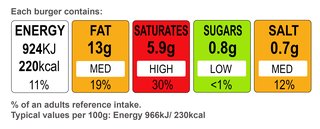
Some forepart-of-pack nutrition labels use cherry, amber and green colour coding.
Color-coded nutritional data tells you at a glance if the food has high, medium or depression amounts of fat, saturated fat, sugars and salt:
- red means loftier
- amber means medium
- greenish means depression
In brusk, the more than green on the label, the healthier the choice. If you buy a food that has all or by and large green on the characterization, you know direct away that it's a healthier choice.
Amber means neither loftier nor low, then you tin can eat foods with all or generally amber on the characterization most of the time.
But any cherry on the label means the food is high in fat, saturated fat, table salt or sugars, and these are the foods we should cutting down on.
Try to swallow these foods less often and in small amounts.
Ingredients listing
Most pre-packed food products as well take a list of ingredients on the packaging or an fastened label.
The ingredients listing tin can also help you piece of work out how healthy the product is.
Ingredients are listed in order of weight, so the main ingredients in the packaged nutrient e'er come up start.
That ways that if the start few ingredients are high-fatty ingredients, such every bit foam, butter or oil, then the food in question is a high-fat food.
Food shopping tips
You're continuing in the supermarket aisle looking at ii similar products, trying to make up one's mind which to cull. You want to brand the healthier choice, but you lot're in a hurry.
If you're buying prepare meals, cheque to see if in that location's a diet label on the front of the pack, and and then see how your choices stack upwards when information technology comes to the amount of energy, fatty, saturated fat, sugars and salt.
If the nutrition labels use colour coding, you lot'll often find a mixture of red, amber and light-green.
And then when you're choosing between similar products, try to become for more greens and ambers, and fewer reds, if you desire to make a healthier choice.
But remember, even healthier gear up meals may be college in fat and free energy than the bootleg equivalent.
And if yous make the meal yourself, you could likewise save money.
Become tips on how to eat on a budgetttt
Labelling terms and food safety
To find out more about nutrient labels, including what terms such equally "calorie-free/low-cal" and "low fat" hateful, and the difference between "apply by" and "best before", read more about food labelling terms.
Source: https://www.nhs.uk/live-well/eat-well/food-guidelines-and-food-labels/how-to-read-food-labels/

ارسال یک نظر for "What Refers to the Number of Nutrients Per Calorie of a Particular Food?"